
Early life and personal background:
Bill Gates, whose real name is William Henry Gates III, was born on October 28, 1955, in Seattle, Washington. He is an American businessman, software developer, and philanthropist, best known as the co-founder of Microsoft which he started in 1975 with his childhood friend Paul Allen. This company played a major role in the microcomputer revolution of the 1970s and 1980s. After Microsoft’s public launch in 1986, Bill Gates became a billionaire at the age of 31, the youngest at that time. From 1995 to 2017, he was named the world’s richest person for many years, and in 1999, he became the first person to have a net worth of over $100 billion. As of May 2025, his net worth is about $115.1 billion, ranking him the 13th richest person in the world.
Bill Gates grew up in Seattle, Washington, and studied at Lakeside School, where he developed an interest in computers. He later attended Harvard University in 1973 but left in 1975 to focus on Microsoft. He served as Microsoft’s CEO for 25 years before stepping down in 2000. Over the years, he also served as chairman, chief software architect, and later technology adviser. In 2020, he left the company’s board.
Early Education and academic journey:
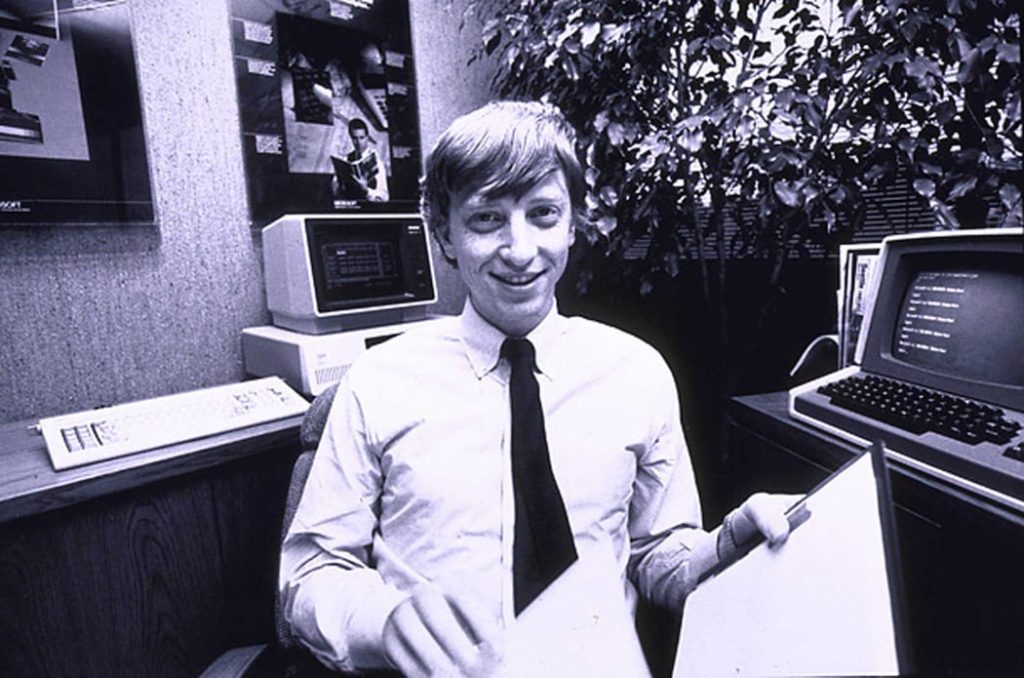
At the age of 13, Bill Gates joined Lakeside School, a private preparatory school, where he discovered his passion for computers. The school’s Mothers’ Club bought a computer terminal and time on a General Electric mainframe. Gates quickly learned programming in BASIC and created his first program—a tic-tac-toe game where users played against the computer.
At 17, Gates and Allen started a small business called Traf-O-Data, creating traffic counting systems. In 1973, he graduated from Lakeside as a National Merit Scholar, scoring 1590 out of1600 on the SAT. That same year, he enrolled at Harvard University, where he studied advanced mathematics and computer science.
While at Harvard, Gates met Steve Ballmer (future Microsoft CEO) and developed an algorithm for pancake sorting, which became a recognized computer science solution. In 1974, Gates worked at Honeywell with Allen.
In 1975, after the release of the MITS Altair 8800 microcomputer, Gates and Allen saw an opportunity to start their own software company. Gates dropped out of Harvard to pursue the idea, with full support from his parents, saying he could always return to school if it didn’t work out.
In 2016, Gates revealed he is color-blind. He tested positive for COVID-19 in May 2022 but experienced only mild symptoms, having received three vaccine doses. In his 2025 memoir Source Code, Gates shared that he believes he is autistic.
Marriage, Family, and Divorce:
In 1987, Bill Gates met Melinda French at a trade fair in New York. She had recently started working at Microsoft. They got engaged in 1993 and married on January 1, 1994, in Hawaii. The couple had three children—two daughters and a son.
On May 3, 2021, Bill Gates and Melinda announced their divorce after 27 years of marriage. Reports suggested that Melinda had concerns about Gates’s connection to Jeffrey Epstein and began meeting divorce lawyers in 2019, but the couple delayed the separation until their youngest child graduated from high school. The divorce was finalized on August 2, 2021.
Microsoft:
Basic and the Beginning:
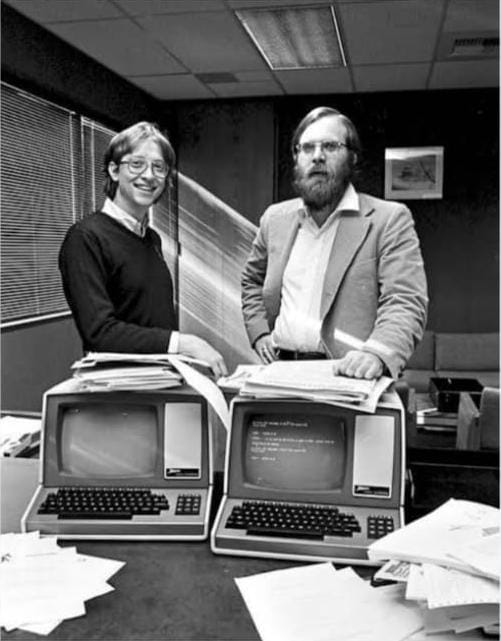
In January 1975, Bill Gates read an article in Popular Electronics about the Altair 8800 computer. He and Paul Allen contacted the company that made it—MITS—claiming they had developed a BASIC programming language for it (even though they hadn’t yet). MITS agreed to a demonstration, so they quickly built an Altair emulator and the BASIC program. The demo was a success, and MITS began selling their Altair BASIC.
Bill Gates took a break from Harvard to work at MITS, and Allen named their new company Micro-Soft (from microcomputer and software). The name later became Microsoft. Their first hire was Ric Weiland, a friend from high school.
When Gates found out people were copying Altair BASIC without paying, he wrote an open letter in 1976 arguing that software developers should be paid for their work. Microsoft became independent from MITS later that year, moved to Bellevue, Washington in 1979, and Gates personally reviewed almost every line of code in the early years.
Windows and Growth:
To compete with Apple’s Macintosh, Microsoft launched the first version of Windows in 1985. In 1986, they began working with IBM on another system called OS/2, but creative disagreements ended the partnership.
Windows evolved over the years, leading to Windows 95 (which hid DOS by default), Windows XP (released after Gates stepped down as CEO), and later versions. Gates left his role as chairman in 2014.
Financial Status:
When Microsoft went public in 1986, Bill Gates owned 44.9% of the company. By 1987, he became the youngest self-made billionaire in history. For many years, he topped the Forbes list of richest people, with his net worth sometimes exceeding $100 billion.
His wealth has fluctuated due to changes in Microsoft’s stock price and his large charitable donations. Even after stepping down from Microsoft, Bill Gates remained one of the richest people in the world, with a net worth of about $108.8 billion in February 2025.
Bill Gates supports higher taxes for the wealthy and has said he has paid over $6 billion in taxes. He also has many investments outside Microsoft, including founding Corbis (a digital image company) and serving on the board of Berkshire Hathaway alongside his friend Warren Buffett.
Business Ventures and Investments:
Beyond Microsoft, Bill Gates has invested in and founded many companies, including:
Cascade Investment LLC – his private investment firm, which also makes him the largest private farmland owner in the U.S. (242,000 acres).
AutoNation – 16% stake in the car retailer.
Canadian National Railway – largest single shareholder.
TerraPower – nuclear power innovation company.
Breakthrough Energy Ventures – funds green startups and climate solutions.
Impossible Foods – plant-based meat alternatives.
Carbon Engineering – carbon capture technology.
EarthNow – live satellite video coverage of Earth.
Ecolab – 11.6% stake in water and hygiene technology.
ResearchGate – scientific networking platform.
Luminous Computing – AI hardware.
Mologic – low-cost COVID-19 test developer.
He has also invested in aviation, biotech, and digital media ventures.
Bill Gates approach to Climate solutions and clean Energy:
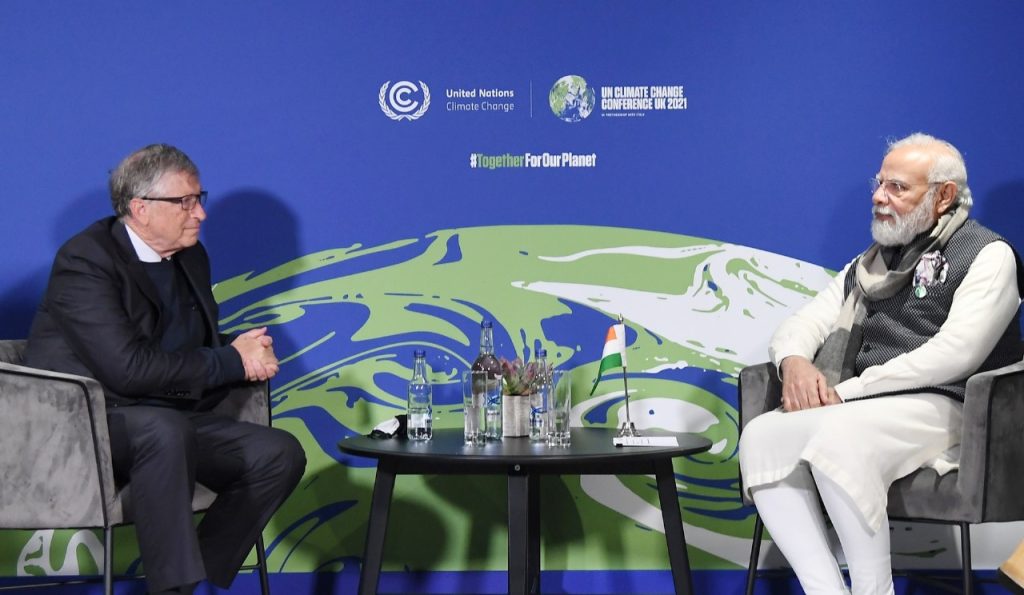
With Indian Prime Minister Narendra Modi at the COP26 climate
summit in Glasgow in November 2021.
Bill Gates sees climate change and global access to energy as deeply connected, urgent challenges. He believes that governments and the private sector must invest heavily in research and development to make clean, reliable energy more affordable. According to Bill Gates, a breakthrough in sustainable energy technology could simultaneously reduce greenhouse gas emissions, lower poverty, and stabilize global energy prices.
In 2011, Gates remarked, “If you gave me the choice between picking the next 10 presidents or ensuring that energy is environmentally friendly and a quarter as costly, I’d pick the energy thing.”
By 2015, he stressed the urgent need to shift the world’s energy system away from fossil fuels toward sustainable sources—a transition that has historically taken decades. Gates argued that innovation is now moving faster than ever and that the global urgency to act is unprecedented. This shift, he said, requires greater government funding for basic research and bold privatesector investments in high-risk areas such as advanced nuclear energy, large-scale energy storage for wind and solar, and solar fuel technologies
At the 2015 United Nations Climate Change Conference in Paris, Gates launched two major initiatives. The first, Mission Innovation, involved 20 national governments pledging to double their carbon-free energy research budgets within five years. The second, Breakthrough Energy, brought together investors committed to funding high-risk clean energy startups. Gates invested $1 billion of his own money into innovative energy ventures and promised an additional $1 billion for Breakthrough Energy projects. In December 2020, he called for the U.S. government to create clean energy research institutes modeled after the National Institutes of Health. He also urged wealthy nations to transition entirely to synthetic beef to reduce agricultural greenhouse gas emissions.
Regulation of the Software Industry:
In 1998, Gates testified before the U.S. Senate, rejecting the need for government regulation of the software industry. During the Federal Trade Commission’s investigation of Microsoft in the 1990s, Gates reportedly became upset with Commissioner Dennis Yao, who had floated hypothetical scenarios suggesting limits on Microsoft’s growing monopoly power. According to one account, Gates criticized Yao’s ideas as socialistic and, growing increasingly angry, escalated to calling them Communistic.
Patents for COVID-19 Vaccines:
In April 2021, during the COVID-19 pandemic, Bill Gates faced criticism for arguing that pharmaceutical companies should retain patents for COVID-19 vaccines. Critics, including Tara Van Ho of the University of Essex, said this position could prevent poorer nations from securing adequate vaccine supplies. Bill Gates also opposed the proposed TRIPS waiver, which would have suspended certain intellectual property protections to increase global vaccine access.
Bloomberg reported that Gates had advised Oxford University not to freely release the rights to its COVID-19 vaccine research, as it initially intended, but instead to license the technology to a single commercial partner. Observers linked his stance on medical patents to his long-standing defense of software intellectual property rights.
Philanthropy of Bill Gates:
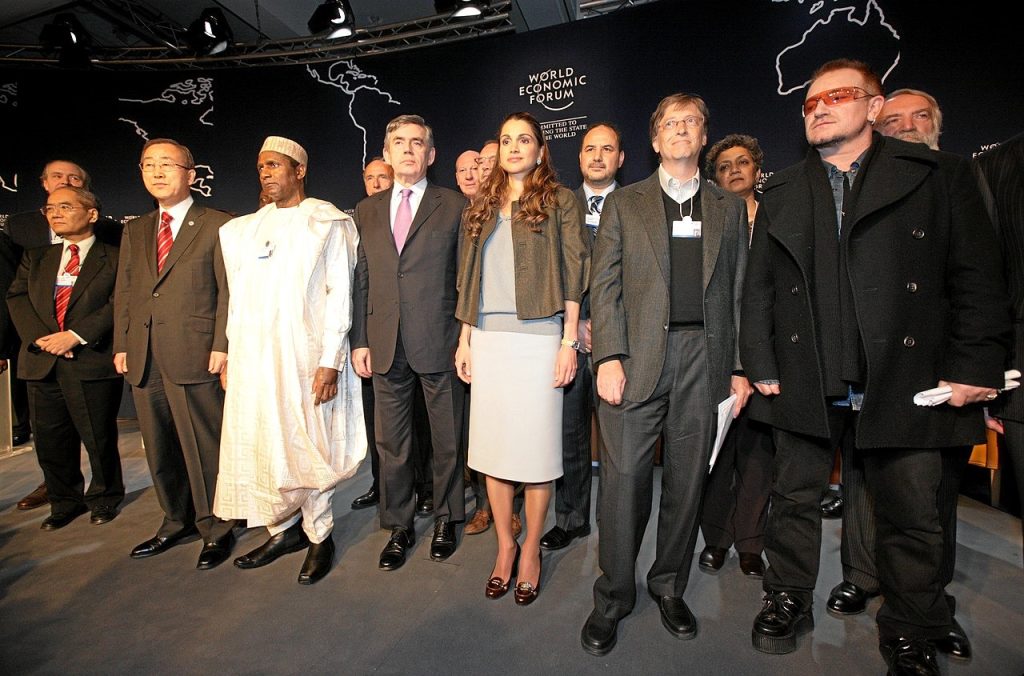
Gates with Bono, Queen Rania of Jordan, then British Prime Minister Gordon Brown, then President of Nigeria Umaru Yar’Adua and others during the Annual Meeting 2008 of the World
Economic Forum
Bill Gates has donated around $100 billion to charity, with $60 billion going to the Bill & Melinda Gates Foundation.
He started his first charity, the William H. Gates Foundation, in 1994, and in 2000 merged it with other family foundations to create the Bill & Melinda Gates Foundation, now the largest charitable foundation in the world.
The foundation works on global health, education, agriculture, and sanitation projects, such as:
Supporting schools, libraries, and scholarships.
Funding research on crops like Golden Rice to combat malnutrition.
Notable efforts include:
Funding Alzheimer’s research ($100 million).
Providing aid for natural disasters (like floods in India).
Offering free ebooks to students worldwide.
Playing charity tennis matches with Roger Federer, raising millions for African children.
Gates has said his goal is to eventually leave the list of the world’s richest people and give virtually all his wealth to good causes.
Books by Bill Gates:
1) In 1989, Gates wrote the foreword for Learn BASIC Now, about the BASIC programming
language.
2) The Road Ahead (1995) – Co-authored with Nathan Myhrvold and Peter Rinearson,
discussing the future impact of computers and the internet.
3) How to Avoid a Climate Disaster (2021) – Solutions and innovations to fight climate change.
4) How to Prevent the Next Pandemic (2022) – Ideas for creating a global team to stop future
pandemics.
Controversies about Bill Gates:
Gates giving his deposition at Microsoft on August 27, 1998
- Antitrust Case with Microsoft (1998)
The U.S. government accused Microsoft of monopolistic practices — meaning it used its power to crush competitors.
Example: Bundling Internet Explorer with Windows, making it harder for other browsers like Netscape to survive.
Bill Gates appeared in a videotaped deposition where he gave short, defensive answers that made him look evasive.
The judge ruled that Microsoft had violated antitrust laws, leading to a settlement and some
business restrictions.
- Workplace Behavior & Paul Allen Dispute:
Gates was famous for being very intense and demanding with employees.
In meetings, he often called ideas “stupid” if he disagreed, though many later said it pushed them to work harder.
Paul Allen, Microsoft’s co-founder, claimed Gates tried to reduce his ownership in the company when Allen was sick with cancer in the early 1980s.
Gates denied any bad intentions, saying it was just a business discussion.
- Jeffrey Epstein Connection:
Bill Gates said he was trying to involve Epstein in fundraising for charity projects, but later
admitted meeting him was a mistake.
According to reports, Epstein tried to use a personal matter to pressure Gates, though Gates says
nothing improper happened.
The association hurt Gates’s public image, especially after his divorce from Melinda French
Gates in 2021.
Recognition of Bill Gates:
Time Magazine named Bill Gates as one of the 100 most influential people of the 20th century (1999) and again in 2004, 2005, and 2006. In 2005, he and Melinda were named Persons of the Year for humanitarian work.
Won many leadership and influence awards, including CEO of the Year (1994) and top rankings
in media and tech influence lists.
Received honorary doctorates from top universities worldwide, including Harvard, Cambridge,
and Tsinghua University.
Engineering & Tech Honors: Elected to the U.S. National Academy of Engineering (1996),
awarded Distinguished Fellow of the British Computer Society (1994).
A species of flower fly, Eristalis gatesi, was named after him (1997).
Along with Melinda, won major humanitarian awards like the Jefferson Award (2002) and the
James C. Morgan Global Humanitarian Award (2006).
Received international honors from many countries:
- UK: Honorary Knight Commander of the Order of the British Empire (2005).
- Portugal: Grand Cross of the Order of Prince Henry (2006).
- Mexico: Order of the Aztec Eagle (2006).
- India: Padma Bhushan (2015).
- France: Legion of Honour (2017).
- Japan: Grand Cordon of the Order of the Rising Sun (2020).
- Pakistan: Hilal-e-Pakistan (2022).
- Nigeria: Commander of the Order of the Federal Republic (2025).
Other awards: Presidential Medal of Freedom from Barack Obama (2016), Silver Buffalo Award from Boy Scouts of America (2010), and the Bower Award for Business Leadership (2010).
In 2019, received the Professor Hawking Fellowship from Cambridge University.
References:
https://web.archive.org/web/20150619062237/http://www.britannica.com/biography/Bill-Gates
https://en.wikipedia.org/wiki/Bill_Gates
https://www.britannica.com/money/Bill-Gates
https://www.thoughtco.com/bill-gates-biography-and-history-1991861